
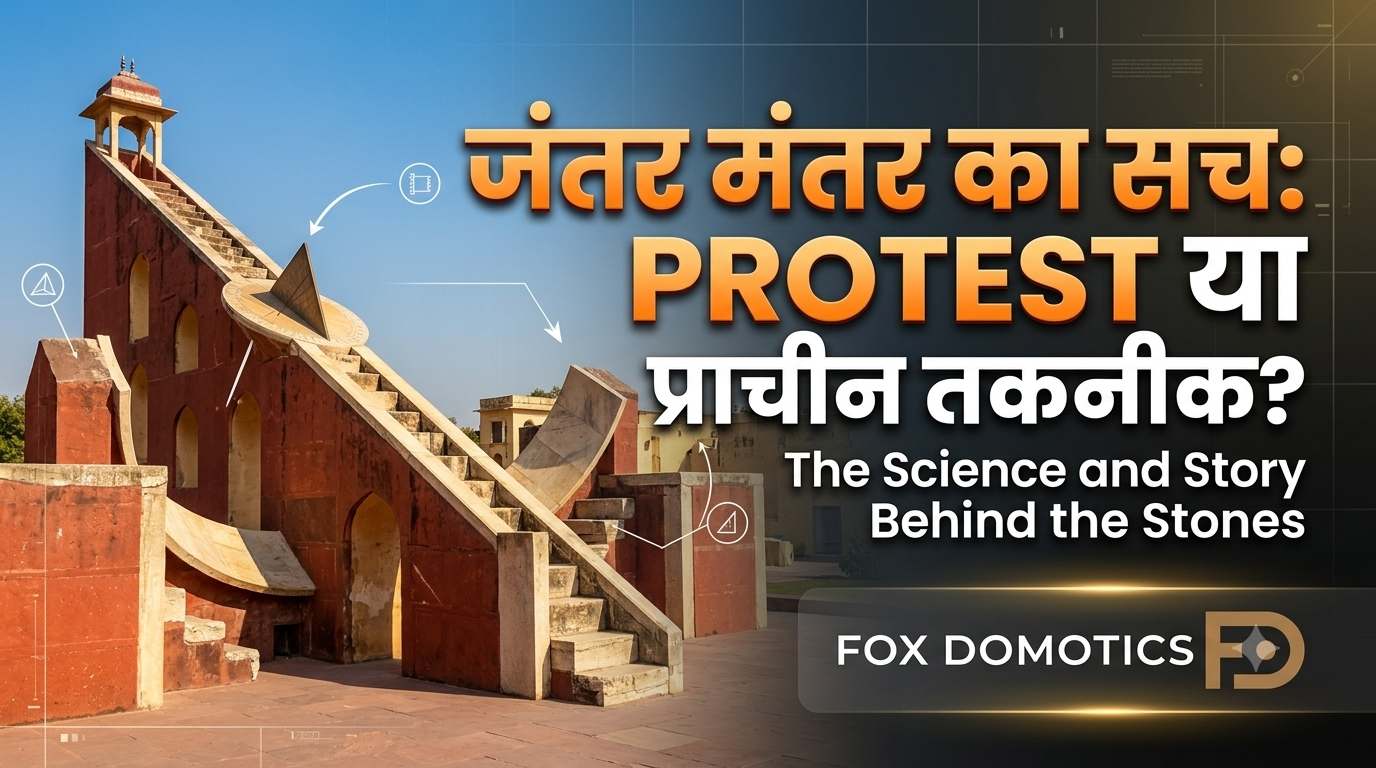
When people hear the name Jantar Mantar, most immediately think of two things—an old monument in Delhi or a place where protests are held.
Very few realize that nearly 300 years ago, this remarkable structure represented one of the world’s most advanced centers for astronomical observation. It was a place where mathematics, engineering, architecture, astronomy, and scientific thinking came together long before the age of computers, satellites, or artificial intelligence.
The story of Jantar Mantar is not just about stones and instruments.
It is a story of curiosity over conflict, science over uncertainty, and collaboration over division.
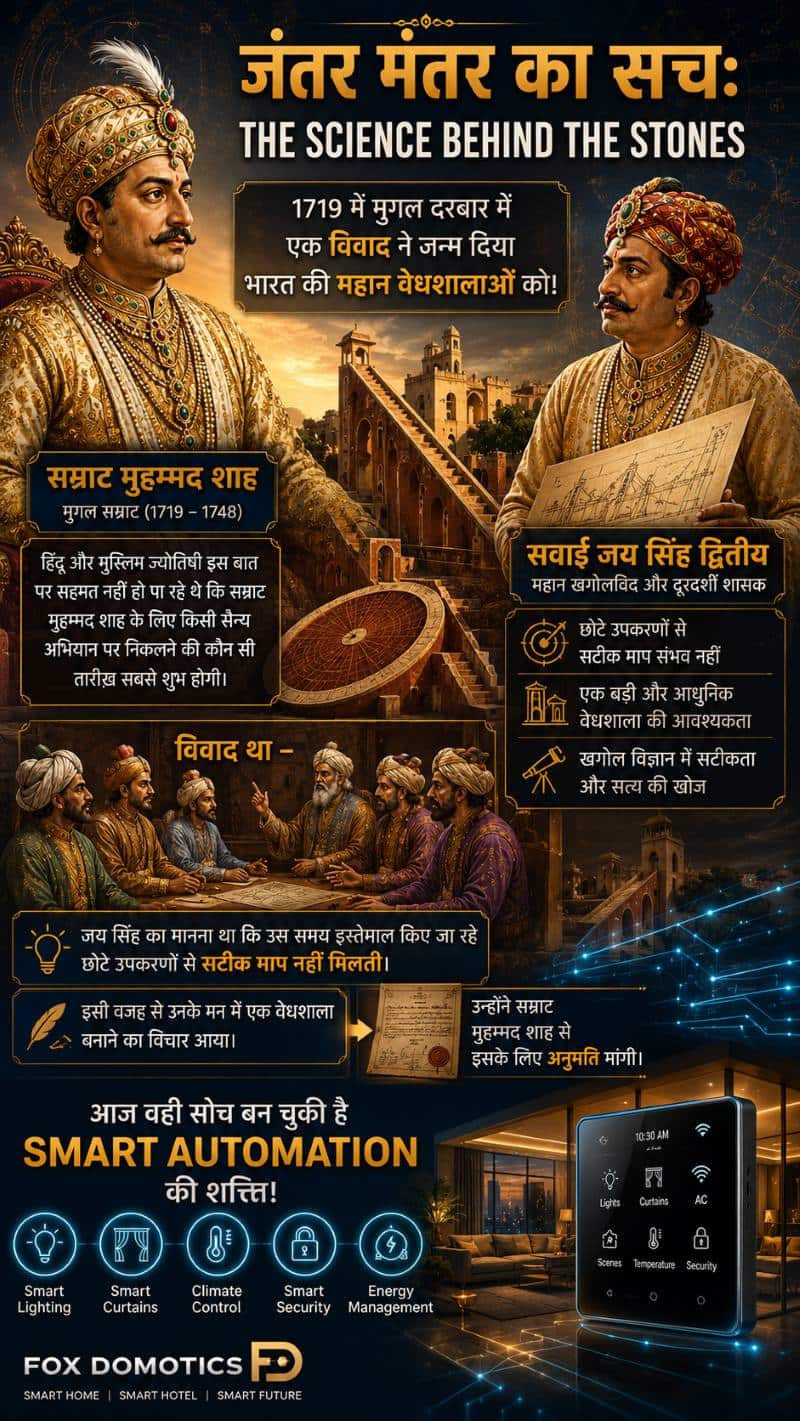
The year was 1719. Inside the Mughal court of Emperor Muhammad Shah, preparations were underway for an important military campaign.
Before the emperor could leave the capital, one important question needed an answer:
Which was the most auspicious day to begin the campaign?
Hindu astrologers and Muslim astrologers presented different calculations.
Each group believed its astronomical methods were correct.
The debate continued for days.
The emperor was not merely facing a disagreement between scholars; he was confronting a practical problem. Decisions affecting an empire required confidence in astronomical calculations.
Among those present was Maharaja Sawai Jai Singh II of Amber (Jaipur).
Unlike many rulers of his time, Jai Singh possessed deep knowledge of mathematics, astronomy, geometry, and engineering.
Instead of taking sides in the debate, he identified the real issue.
The calculations themselves were limited because the available astronomical instruments were too small and lacked precision.
Rather than arguing over opinions, Jai Singh proposed something revolutionary:
Build larger, permanent astronomical instruments capable of producing more accurate observations.
This simple scientific idea would eventually give birth to one of India’s greatest engineering achievements.
One of the most overlooked parts of Jantar Mantar’s history is the role played by Emperor Muhammad Shah.
Without imperial approval, such a massive scientific project could never have been constructed inside the Mughal capital.
Granting permission to a Rajput ruler to build an observatory in Delhi was not a small political decision.
The emperor recognized that accurate astronomical observations benefited everyone.
Religious ceremonies, calendars, agriculture, navigation, royal events, and military planning all depended on reliable knowledge of celestial movements.
Instead of viewing science through political or religious divisions, Muhammad Shah supported an initiative that would improve knowledge for the entire empire.
His decision demonstrated an important principle: A ruler who supports science invests in the future of civilization.
While Mughal Emperor Muhammad Shah provided the political support, Sawai Jai Singh II provided the scientific vision.
In his famous astronomical work, Zij-i-Muhammad Shahi, Jai Singh published an updated catalogue of 1,018 stars and explained why he was building these observatories.
His objective was to improve the accuracy of the Indian calendar system so that festivals, religious ceremonies, agricultural planning, and astronomical calculations could be based on better observations.
This was not merely an architectural project.
It was one of India’s earliest large-scale scientific research initiatives.
Perhaps the greatest lesson from Jantar Mantar is that knowledge has never belonged to a single civilization.
Jai Singh studied ancient Indian astronomical traditions.
Instead of accepting any single source blindly, he compared Indian, Islamic, and European calculations before developing his own conclusions.
This spirit of scientific inquiry remains one of Jantar Mantar’s greatest achievements.
It demonstrates that progress happens when civilizations exchange ideas rather than isolate themselves.
Imagine constructing astronomical instruments capable of measuring celestial positions with remarkable precision…
Yet that is exactly what the engineers, mathematicians, architects, and craftsmen achieved nearly three centuries ago.
The famous Samrat Yantra, Ram Yantra, Jai Prakash Yantra, Misra Yantra, and several other instruments transformed mathematics into architecture.
These were not decorative monuments.
They were precision scientific instruments built on geometric principles.
Even today, engineers and astronomers continue to study their design because they represent one of the finest examples of pre-modern scientific engineering.
Today the world speaks about Artificial Intelligence, Robotics, Automation, Smart Buildings, Digital Twins, Space Technology, IoT, and Data Science.
But every one of these technologies begins with the same four principles that guided Jantar Mantar nearly 300 years ago:
Observe → Measure → Analyze → Innovate
Before a smart building can automate lighting…
Sensors must observe.
Before an AI model makes predictions…
Data must be measured.
Before a satellite calculates its orbit…
Astronomers must understand celestial motion.
Before automation begins…
Observation comes first.
In many ways, Jantar Mantar represents India’s earliest large-scale observation laboratory.
The technology has changed. The scientific process has not.
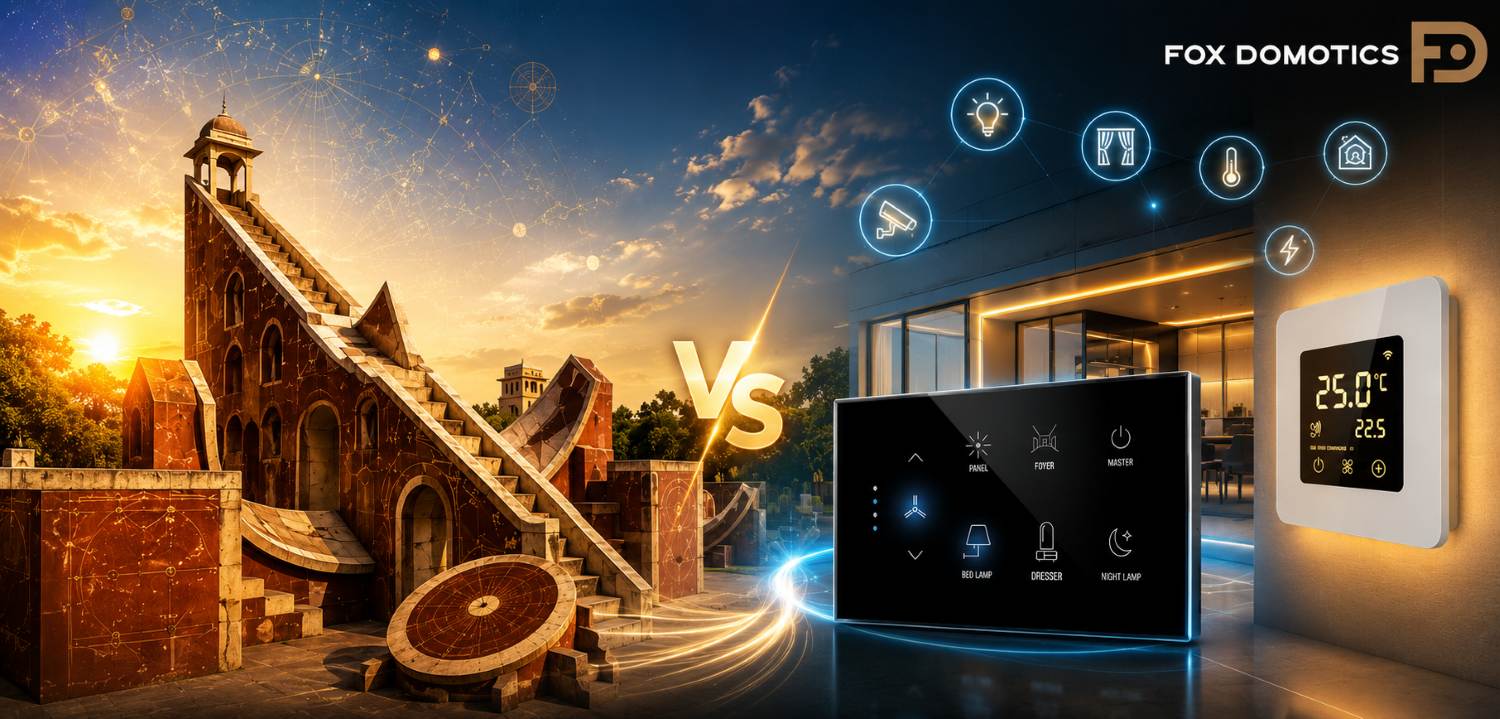
It reminds us that nearly three centuries ago, when a disagreement arose in the Mughal court, the answer was not conflict—it was science.
Emperor Muhammad Shah chose to support knowledge over division. Instead of rejecting Sawai Jai Singh II’s proposal, he encouraged scientific inquiry by granting permission to build one of the world’s most remarkable astronomical observatories in the heart of the imperial capital.
Sawai Jai Singh II, in turn, brought together ideas from Indian traditions, Islamic astronomy, and European scientific knowledge. The result was Jantar Mantar—a monument that proves great discoveries are made when knowledge is shared across cultures.
Today, we live in the age of Artificial Intelligence, Space Exploration, Smart Automation, Robotics, and Data Science.
The spirit behind these modern technologies is the same as it was three hundred years ago: observe carefully, measure accurately, question continuously, and innovate fearlessly.
That is why Jantar Mantar should not be seen merely as an old tourist attraction or a monument of stone.
It should be recognized as an Observation and Educational Centre—a place where students, researchers, engineers, astronomers, architects, and curious minds can learn how scientific thinking shaped India’s past and continues to inspire its future.
Imagine school children standing beside the Samrat Yantra, learning how people measured time without electricity or computers. Imagine engineering students discovering how geometry and mathematics were transformed into massive precision instruments. Imagine future innovators realizing that India’s scientific heritage stretches back centuries.
Jantar Mantar teaches us one timeless lesson:
Civilizations progress when they invest in knowledge, encourage curiosity, and respect scientific inquiry.
Its story is not about one ruler or one community alone. It is about visionary leadership, intellectual collaboration, and the belief that science can unite people in the search for truth.
As India moves toward becoming a global leader in technology, automation, and space science, Jantar Mantar deserves to be celebrated not only as a UNESCO World Heritage Site but also as a living classroom—a symbol of observation, innovation, education, and scientific excellence.
Perhaps the greatest tribute we can pay to Jantar Mantar is not simply preserving its walls, but preserving the spirit with which it was built:
Observe. Learn. Question. Innovate. Share Knowledge. Build the Future.